

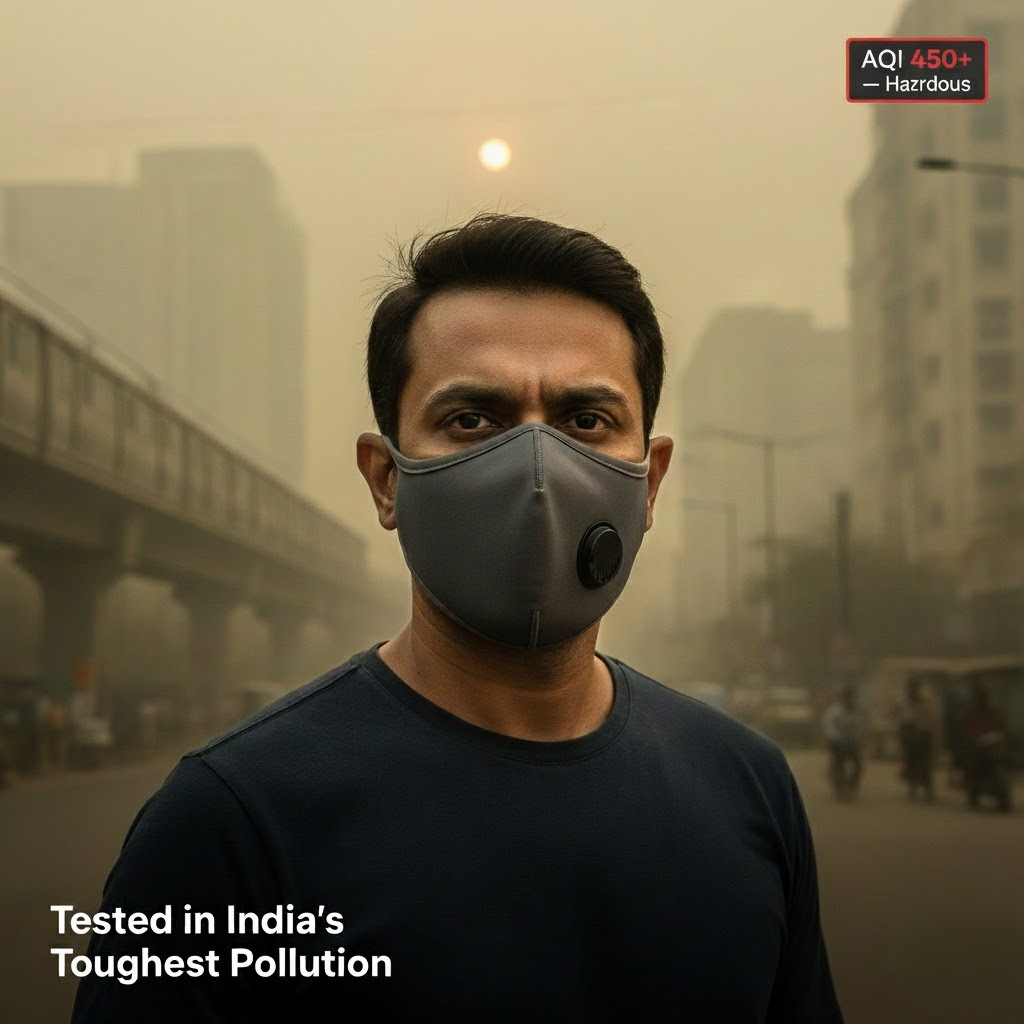
So Delhi's AQI just hit 450 again. And you're wondering if that N99 mask you've been eyeing actually works.
Fair question. Because let's be real, there's a lot of marketing nonsense out there. Brands throwing around numbers like "99% filtration!" without explaining what that means when you're stuck breathing truck exhaust on Ring Road.
I spent four months testing N99 masks across Delhi, Mumbai, and Bangalore during peak pollution season. Not lab testing. Real world use while commuting, walking, exercising outdoors when AQI went bonkers.
Here's what actually happens when you wear an N99 pollution mask in Indian conditions.
Understanding Indian Air Pollution (It's Worse Than You Think)
Before we talk masks, let's talk about what you're actually breathing.
Indian cities don't just have one type of pollution. You're getting hit with PM2.5 particles. Yes the tiny ones that slip past your body's natural defenses and lodge deep in your lungs. Plus PM10, vehicle emissions, stubble burning smoke, industrial pollutants, and dust storms in northern regions.
And it changes throughout the day. Morning rush hour? Worst for vehicle emissions. Evening sees cooking smoke added to the mix.
Why AQI Numbers Matter for Mask Choice
Here's the thing about AQI levels. They're not just numbers on an app.
AQI 0-50: Good air. You don't need a mask.
AQI 101-200: Unhealthy for sensitive groups. Light masks work.
AQI 201-300: Unhealthy for everyone. N95 minimum recommended.
AQI 301-500: Very unhealthy to hazardous. N99 masks become necessary.

Delhi regularly crosses 400 during winters. Mumbai's industrial zones hit 300+ during certain months. Even Bangalore sees spikes above 200 near high traffic areas.
At those levels? The difference between N95 and N99 mask for air pollution protection becomes significant.
How N99 Masks Actually Filter Pollution
Let's break down what "99% filtration" means in real terms.
N99 masks use multi layer filtration which typically has 4-6 layers depending on the brand. Each layer catches different particle sizes.
The outer layer blocks large particles. Middle layers have electrostatically charged fibers that attract tiny particles. Activated carbon absorbs gases and odors. Inner layer is soft material against your skin.

That "99%" means the mask captures 99 out of every 100 particles that are 0.3 microns or larger.
Why 0.3 microns? Because that's actually the hardest size to filter. Smaller particles get caught through diffusion. Larger ones get blocked mechanically.
What N99 Catches (And What It Doesn't)
N99 pollution masks are excellent against:
-
PM2.5 and PM10 particles, the main villains in Indian air
-
Dust, pollen, and allergens
-
Bacteria and most viruses
-
Smoke particles from stubble burning
-
Construction dust and debris
But here's what surprises people. N99 masks don't protect against gases like carbon monoxide or nitrogen dioxide.
For that, you need activated carbon layers. Not all N99 masks include them.
Real World Testing: Delhi Edition
I tested three different N99 masks during Delhi's November pollution crisis. AQI was consistently above 400.
Morning Commute Results
Wore an N99 mask during a 45 minute metro + auto commute.
Before wearing it? Throat irritation within 20 minutes. Eyes burning. That metallic taste in your mouth from pollution.
With the N99 mask? Noticeably cleaner air. No throat irritation. Could actually breathe without feeling like I was inhaling sandpaper.

The air valves made a difference. Previous masks I tried felt suffocating. Better designed N99 masks let me breathe normally while still filtering everything out.
Exercise Test (The Real Challenge)
Here's where most masks fail. Went for a morning jog in Lodhi Garden. AQI around 380.
Without mask: Gave up after 10 minutes. Lungs felt like they were on fire.
With N99 mask: Completed a 30 minute run. Breathing resistance was there, can't lie about that. But manageable. The 6 layer filtration kept working even when I was breathing hard.
Key learning? If you're doing any physical activity in high pollution, N99 masks are non negotiable.
Mumbai Testing: Different Pollution Profile
Mumbai's pollution is different from Delhi's. Less stubble burning, more vehicle emissions and industrial pollutants.
The sea breeze helps with air quality generally. But heavy traffic corridors still see AQI spikes to 250-300.
Tested N99 mask effectiveness during evening traffic. Could smell vehicle exhaust with cheaper masks. With N99 pollution masks using activated carbon? That chemical odor was blocked.
The carbon layer matters in Mumbai more than Delhi. Vehicle emissions include gases that regular filtration doesn't catch.
Suburban Train Commute
Packed train, people coughing, poor ventilation.
N99 masks provide bacterial and viral protection too. Given how many people were visibly sick during flu season, having that extra layer of protection felt worth it.
One hour commute in a crowded train? No respiratory irritation. No that "shared air" feeling you normally get.
N99 vs N95: When The Upgrade Matters
Let me be direct. N99 vs N95 mask choice depends on your pollution exposure level.
When N95 Works Fine
If you're in cities with AQI usually below 200, indoor heavy lifestyle with limited outdoor exposure, or occasional high pollution days, then N95 masks provide adequate protection.
When N99 Becomes Necessary
But if you're dealing with AQI regularly above 300, daily commutes through high traffic areas, respiratory conditions like asthma, outdoor work requiring extended exposure, or pollution season in northern India, then that 4% difference matters.
Think about it. If you're exposed to 10,000 pollution particles:
-
N95 lets 500 through
-
N99 mask only allows 100 through
Over months of daily exposure? Those numbers compound.
The Fit Problem (Why Most Masks Don't Work)

Here's something nobody tells you. Even the best N99 pollution mask fails if it doesn't fit properly.
Any gap between the mask and your face creates bypass airflow. Polluted air takes the path of least resistance through gaps, not through filtration layers.
Quick test: Breathe out hard. If air escapes from the sides, your seal sucks.
Good N99 masks include adjustable nose clips that actually mold to your face shape, multiple ear loop positions, and chin coverage that doesn't leave gaps when you talk.
The newer N99 masks with adjustable designs actually seal properly. Previous one size fits all straps left gaps everywhere.
Long Term Cost Reality
Let's talk money. Because N99 mask price seems high until you do the math.
Most disposable N99 masks cost ₹100-200 each. They're rated for 8-12 hours of use.
Daily commuter? That's roughly one mask per day. Over six months: 180 masks needed. Cost: ₹18,000-36,000.
Reusable N99 masks with replaceable filters change this equation.
Take something like the atovio Nova N99 Mask at ₹599. Comes with 4 replaceable filters, each lasting ~21 days. For six months of daily use, you're looking at roughly ₹3,000 total including replacement filters.
That's 6-12 times cheaper than disposables. Plus you're not throwing away 180 masks.
The reusable route just makes more sense financially and environmentally.

Buying Guide: What To Look For
Shopping for N99 masks? Here's what actually matters.
Must Have Features
CDSCO or similar certification which prove actual 99% filtration. Multiple filtration layers (4 to 6). Activated carbon layer for gas/odor protection. Adjustable nose clip and ear loops. Washable and reusable design.
Red Flags
Price under ₹100 for "N99" masks (probably fake). No certification visible anywhere. One size fits all with no adjustments. Synthetic fabric that traps heat against your face.
Where To Buy
It's best to buy directly from brand websites if and when possible. Brands like atovio offer their N99 masks directly online with guaranteed authenticity.
Amazon and Flipkart work if you stick to official brand stores. Just avoid random sellers on marketplaces, the fake mask market is massive in India.
Stop Throwing Away ₹10,000+ on Disposable Masks
99.6% filtration. Washable & reusable. Total cost: ₹1,799 for 6 months.
Shop atovio Nova N99 Mask →Bottom Line: When N99 Makes Sense
After four months of real world testing, here's my take.
N99 pollution masks are worth it if you live in cities with AQI regularly above 300, commute daily through heavy traffic, have respiratory sensitivities, work outdoors during pollution season, or want maximum available particle protection.
For moderate, occasional pollution? N95 does the job and costs less.
But for serious, sustained pollution exposure especially in northern India during winter that extra 4% filtration in N99 masks translates to genuinely better lung protection over time.
The key is finding quality options with proper certifications (look for CDSCO approval), comfortable breathable materials like cotton, good fit adjustability, and reasonable long term costs through reusability. The 6 layer EAPI filtration technology in newer N99 masks offers better protection than older 3-4 layer designs.
Stay safe out there. Delhi's AQI isn't getting better anytime soon.

Share:
Best N95 Mask in India: Tested & Reviewed (2025)
How Effective Is The Atovio Pebble? IIT Kanpur Test Results Might Shock You!