

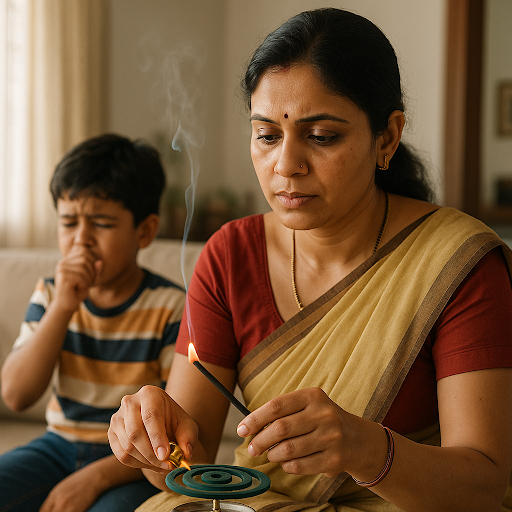
They’re found in almost every Indian household-agarbattis (incense sticks) during daily prayers and mosquito coils for keeping bugs at bay. Marketed as “natural” and “eco-friendly,” these products might seem harmless. But science tells a different story. Burning agarbatti and mosquito coils releases fine particulate matter, carcinogens, and toxic gases that severely degrade indoor air quality. Let’s unpack the hidden dangers behind these cultural staples and how you can protect your home.
What’s Really in Your Agarbatti and Mosquito Coil?
Despite labels claiming “natural” or “organic,” many commercially available incense sticks and coils contain:
-
Charcoal or sawdust as base materials that produce smoke
-
Synthetic fragrances made from petroleum derivatives
-
Binders and oxidizers like potassium nitrate
-
Pesticides (in coils) such as allethrin and pyrethroids
These components, when burned, release harmful emissions into your indoor environment.

Harmful Pollutants Emitted Indoors
1. PM2.5 and PM10 (Particulate Matter)
-
Fine particles that lodge deep into the lungs
-
Causes respiratory inflammation, asthma attacks, and reduced lung function
2. Volatile Organic Compounds (VOCs)
-
Formaldehyde, benzene, and toluene are common
-
Can irritate the eyes, throat, and may even cause cancer with long-term exposure
3. Carbon Monoxide (CO)
-
Displaces oxygen in the bloodstream
-
High exposure can be fatal in poorly ventilated rooms
4. Polycyclic Aromatic Hydrocarbons (PAHs)
-
Result from incomplete combustion
-
Linked to DNA damage and cancer
Health Risks Backed by Science
-
Environmental Engineering Research (2021): Found that burning a mosquito coil releases PM2.5 equivalent to 100 cigarettes per hour (source).
-
The Lancet (2019): Reported links between indoor incense burning and increased lung cancer and asthma rates (source).
-
Harvard T.H. Chan School of Public Health: Highlighted the adverse health effects of incense smoke including eye, throat irritation, and respiratory issues (source).
-
A study in Environmental Engineering Research (2021) found that burning one mosquito coil can emit as much PM2.5 as 100 cigarettes.
-
Lancet reports have linked indoor burning of incense to elevated risks of lung cancer and childhood asthma.
-
The Harvard T.H. Chan School of Public Health observed increased rates of headaches, sinus issues, and eye irritation in homes with frequent incense use.
Who Is Most at Risk?
-
Children with developing lungs and immune systems
-
Pregnant women, due to fetal sensitivity to toxins
-
Elderly and asthma patients

Better Alternatives for Fragrance and Pest Control
Safer Fragrance Options
-
Essential oil diffusers with natural plant extracts
-
Beeswax or soy-based aroma candles
Safer Mosquito Solutions
-
Electric repellents with herbal oil bases (citronella, neem, eucalyptus)
-
Mosquito nets and UV light traps
Ventilation Is Key
Even if you must burn agarbatti or coils:
-
Keep windows open
-
Use exhaust fans or air purifiers to remove pollutants
-
Limit duration and frequency of use

Sacred Doesn’t Always Mean Safe
Incense and coils may be culturally rooted and even spiritually significant, but their impact on indoor air quality cannot be ignored. As more studies reveal the toxic load they carry, it’s time to adopt cleaner, healthier alternatives that protect your home and health.
Rethink your rituals. Choose safety without compromising tradition.
Share:
Can Air Pollution Cause Hair Loss? The Shocking Truth
What All Pollutants Are There in the Air, Their Causes and Effects