


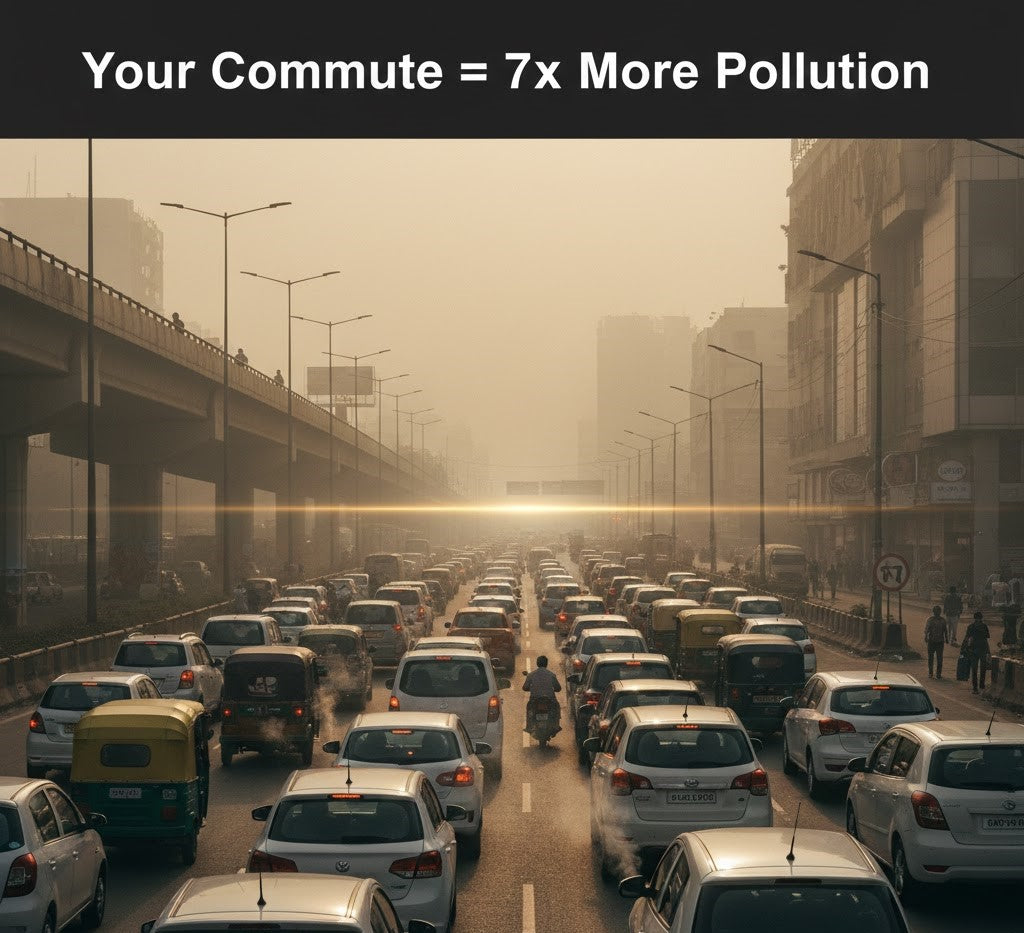
Your daily commute exposes you to 7 times more pollution than any other part of your day. You sit in traffic thinking the car windows protect you or ride your two wheeler assuming exposure is temporary. Wrong on both counts.
Your breathing zone during commute sits at exact height where vehicle exhausts concentrate. That 45 minute commute twice daily adds up to more lung damage than the entire rest of your day combined.
TL;DR
Traffic pollution during commute exposes you to 3 to 7 times higher pollutant levels than indoor air. Studies tracked commuters across vehicle types and the exposure differences are shocking.
The commute exposure reality:
-
Two wheeler riders breathe 4 to 5x more pollution than car passengers
-
Stop and go traffic creates emission spikes 10x higher than free flowing conditions
-
Your breathing zone sits at exhaust pipe height regardless of vehicle type
-
Rush hours combine maximum traffic with temperature inversions trapping pollutants
-
45 min commute twice daily equals 7.5 hours weekly in worst air quality
This is measured data from air quality monitors worn by actual commuters in Delhi, Mumbai, and Bangalore traffic. Lung damage happening in real time every day.
Want to know how to protect yourself during commutes? Keep reading.
Why Is Your Daily Commute So Much Worse for Air Quality?
Traffic pollution during rush hours is dramatically concentrated in ways that maximize your exposure. Between 7am and 10am and 6pm to 9pm, thousands of vehicles occupy the same road space simultaneously.
Vehicle concentration in underpasses, tunnels, and narrow streets creates pollution chambers. Emissions have nowhere to disperse. Stop and go traffic produces 3 to 5 times more pollutants than steady speed driving. Every traffic light, every jam concentrates emissions exactly where you are breathing.
Your breathing zone sits at exhaust pipe level whether in sedan, SUV, two wheeler, or walking. Tailpipe emissions exit at 1 to 3 feet height. Your face is at 3 to 4 feet. Fresh emissions hit you before dispersion happens.
Research measuring traffic pollution exposure found roadside concentrations 5 to 10 times higher than ambient air just 50 meters away from the road.
The atovio Nova N99 Mask provide proven filtration protection for commuters across all vehicle types.
Understanding Vehicle Emissions: What Are You Breathing?
Vehicular pollution is a toxic mix of compounds damaging your respiratory and cardiovascular systems. PM2.5 and PM10 from fuel combustion brake dust tire wear.. These lodge in lungs and cross into bloodstream. Nitrogen oxides from engine combustion cause airway inflammation and reduced lung function. Carbon monoxide from incomplete burning reduces oxygen delivery to organs. Volatile organic compounds including benzene and formaldehyde, many are carcinogens actually.
Sulfur dioxide from diesel engines triggers asthma and respiratory distress. Diesel produces way more particulate matter, like 10 to 100 times more but petrol produces more carbon monoxide and VOCs. Both harmful through different mechanisms sure. Mixed pollutant exposure creates way worse health outcomes than any single pollutant alone. Your body fights inflammation from particles while processing carbon monoxide and VOCs at the same time.. Cumulative stress from all these pollutants overwhelms natural defenses.
Does Your Commute Method Change Your Exposure Levels?
Your traffic pollution exposure varies dramatically based on how you commute. Analysis using personal monitors shows shocking differences.
Two wheeler riders face 4 to 5 times more than enclosed vehicles. Zero barrier, breathing zone at perfect height for emissions, wind patterns push pollutants toward you, helmet creates turbulence concentrating particles.
Cyclists experience 2 to 3 times baseline plus increased breathing rate means total intake rivals two wheeler riders despite producing no emissions.
Car passengers with windows closed see 2 to 3 times indoor pollution levels. Windows open increases to 4 to 5 times. AC on recirculation offers some protection but cabin air still exchanges.
Bus and metro commuters get variable exposure. Metro underground stations can have poor ventilation. Pedestrians get 3 to 4 times exposure versus indoor baseline.

Studies tracking commuters with personal air monitors showed two wheeler riders averaged significantly higher exposure during 45 minute commutes versus car passengers and metro users on the same routes.
What Does Daily Traffic Exposure Do to Your Health?
Immediate effects of traffic pollution show within hours. Throat irritation, coughing, watery eyes, headaches, fatigue, chest tightness. Most dismiss as normal.
Long term impacts from years of exposure include chronic respiratory diseases, cardiovascular disease from inflammation, accelerated lung decline, increased cancer risk, and cognitive decline.
Research found regular commuters in high pollution cities experience increased respiratory issues leading to more sick days and medical costs annually. Prevention costs a fraction of treatment expenses.

Commuters Face 3-7x Higher Pollution Than Indoor Air
Designed for Indian traffic conditions. Atovio Nova N99 Mask 99.6% filtration of vehicle emissions. Helmet-compatible for two-wheeler riders. Breathable for 30-90 minute commutes.
Defend Your Daily CommuteCan Breathing Exhaust Fumes Daily Cause Permanent Damage?
Research on breathing exhaust fumes chronically shows yes, permanent damage occurs. Study tracking Delhi commuters over 5 years found measurable lung capacity reduction in those without protection.
Daily exposure above 100 micrograms PM2.5 for months causes irreversible lung tissue changes. Most two wheeler and many car commuters exceed this regularly.
Highest risk includes children elderly people with respiratory or heart conditions pregnant women and diabetics. Damage is cumulative and often shows no symptoms until significant problems appear years later.
How Can You Protect Yourself from Pollution While Commuting?
Air pollution solutions for commuters combine route and timing modifications with proper protection. Taking side streets instead of highways adds like 5 to 10 minutes but reduces exposure 30 to 40%. That is 30 to 40% less pollution going into your lungs every day. Avoiding 7 to 10am and 6 to 9pm rush hours cuts exposure in half actually. Car commuters should keep windows closed AC on recirculation and replace cabin filters regularly.
Route and timing modifications reduce exposure but cannot eliminate it completely. Physical filtration provides necessary protection. The atovio Nova N99 Mask filters 99.6% of vehicle emissions including PM2.5 and nitrogen oxides through 6-layer EAPI technology with breathable cotton fabric designed for Indian traffic conditions.

When Should You Take Extra Precautions During Your Commute?
Traffic pollution spikes during certain conditions require extra protection.
AQI above 200 means dangerous levels where short exposure causes harm. Diwali season sees pollution spike 3 to 5 times from firecrackers. Stubble burning season October to November creates smoke layer, AQI hits 400 plus. Winter mornings have temperature inversions lasting until 11am trapping overnight pollution.
Complete Air Quality Protection Strategy
Your commute represents your highest pollution exposure, which is why the atovio Nova N99 Mask is essential for travel. But what about the 8 to 10 hours you spend indoors at office or home? Consider complementing your commute protection with portable air purifiers that create clean air zones wherever you work or rest. One can also use regular air purifiers at home or in office, or any other place, which would provide cleaner air when working or resting. A comprehensive protection approach combines outdoor filtration during commutes with wearable air purifiers for indoor environments. Explore complete air quality solutions for every part of your day at atovio.in.
Protection Beyond Your Commute Hours
Wearable air purifier for office and home. Creates clean air zone wherever you are. Filter-free technology with 40+ hour battery. IIT Kanpur validated.
Explore 24/7 ProtectionYour Commute Does Not Have to Damage Your Lungs
Your commute is highest risk period for pollution exposure. That is measured data from thousands of commuters. But high risk does not mean unavoidable damage.
The atovio Nova N99 Mask was designed for Indian commuters.
You cannot change job location or avoid commuting. But you can change how much pollution enters your lungs. Every day without protection is permanent lung damage accumulating. Every day with protection is investment in respiratory health.
For complete protection strategy, see our comprehensive commuter guide. Your lungs are not replaceable. Your commute protection can start today.

Share:
Is It Safe to Walk or Exercise Outdoors When Air Pollution Is High?
When Is the Best Time to Exercise Outdoors in Polluted Cities?