

TL;DR
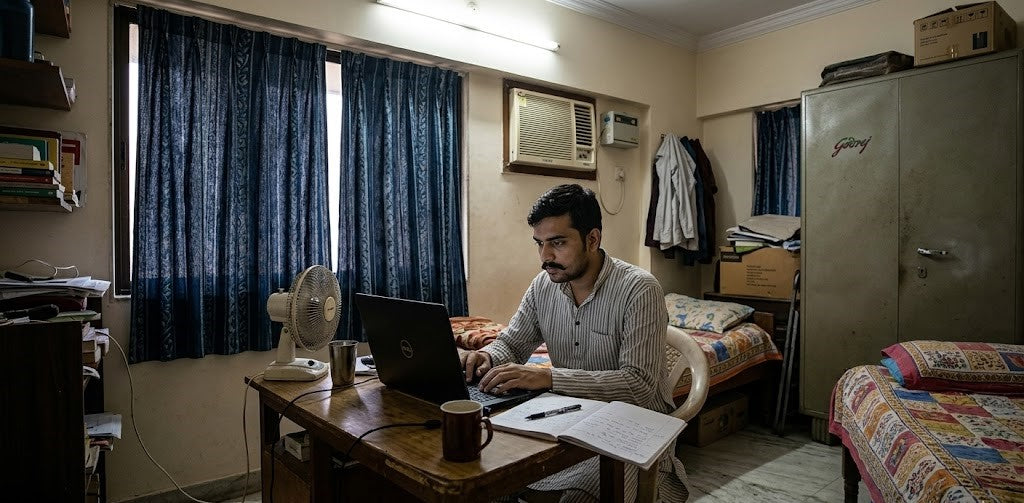
Working from home means spending 8 to 10 hours in the same indoor space, breathing whatever it contains. And most Indian apartments, honestly, have worse air than people realise, even when the windows are closed and everything seems fine. Monitoring is how you find out what is actually in there. Because until you check, you are just guessing.
What WFH professionals are typically breathing without realising:
- PM2.5 from outdoor pollution that infiltrates through gaps, ventilation, and brief door openings
- CO2 that climbs steadily through the morning in any occupied, sealed room
- VOCs from cooking, cleaning products, furniture, and whatever your building materials are off-gassing
- Humidity fluctuations that affect how particles behave and settle in your breathing zone
The assumption that home means clean air is doing a lot of damage quietly.
Want to know how to actually check your home air quality and what to do once you have the numbers? Keep reading.
Why Do Work-From-Home Professionals Need to Monitor Air Quality at Home More Than Anyone Else?
Duration, honestly. That is the whole argument.
An office worker goes home after 8 hours and the exposure stops. A WFH professional stays in the same space, then continues to live in it for the rest of the evening. Total daily exposure to home air is 16 to 18 hours. If there is a problem with that air, you are getting more of it than almost anyone else.
How to monitor air quality at home is not something most people think about until a problem is noticeable. By which point the exposure has usually been going on for weeks, maybe months. Outdoor pollution is easy to track because there are apps, visible haze, news coverage when it gets bad. Indoor pollution just sits there unmonitored while you work through it. Nothing about your environment tells you to pay attention.
For WFH professionals in Indian cities, the outdoor air is not clean to begin with. PM2.5 in most metros regularly exceeds WHO guidelines. That air finds its way indoors, enough to matter across 8 hours of exposure.
What Should an Air Quality Monitor for Home Actually Measure to Give You the Full Picture?
A basic air quality monitor for home that shows a single AQI number is not really giving you enough to work with. AQI rolls multiple pollutants into one figure and different devices weight them differently, so two monitors in the same room can show completely different scores. What you actually want is specific readings.
PM2.5 is the one that matters most for most Indian home offices. It is the particle size that gets deepest into lung tissue, the one behind most of the health effects you hear about with air pollution. You want to see PM2.5 in actual micrograms per cubic metre, not a colour code that tells you roughly what zone you are in.
CO2 matters because it builds up in any room that is not being ventilated properly, and honestly that mid-afternoon foggy feeling WFH workers blame on screen fatigue or burnout? A lot of the time it is just elevated CO2. A monitor showing CO2 in ppm lets you connect the number to how you feel, which turns out to be surprisingly useful.
VOCs and humidity are secondary but worth having. VOC readings catch cooking fumes, cleaning products, off-gassing materials. High humidity keeps particles airborne longer.
Which Air Quality Meter for Home Best Suits a Full-Day WFH Setup and What Readings Should Concern You?
The air quality meter for home that suits a WFH setup best is one you can just leave running at desk height all day. Portability matters less than readability here. A unit with a clear display or an app that logs readings over time is a lot more useful than something you have to actively operate.
PM2.5 above WHO's 24-hour guideline is worth investigating. CO2 above 1000 ppm is where ASHRAE considers cognition to be affected. Most Indian apartments with windows closed hit that CO2 level by mid-morning on a normal WFH day. The bar for concerning numbers is lower than most people expect.
Your Monitor Shows the Problem. Now Protect Your Breathing Zone.
Atovio Pebble is wearable, filter-free, and silent. It treats the air right around you across your entire WFH day. One charge lasts the whole week.
Protect Your WFH Breathing Zone
What Should a Home Air Quality Test Result Show Before You Know Your WFH Environment Is Safe?
A one-time home air quality test is a snapshot. One moment in time. A day of continuous monitoring gives you a pattern and the pattern is what actually tells you something useful.
You want to see whether PM2.5 is climbing through the day or staying roughly flat, whether CO2 peaks before you open anything and then drops once you ventilate, whether cooking or cleaning cause noticeable spikes. A reading taken first thing in the morning before you have done anything will look a lot better than one taken at 2pm. That gap between the two is kind of the whole story.
What Indoor Air Quality Solutions Actually Work for a Typical Indian Apartment Home Office?
The indoor air quality solutions that actually move the needle are fairly specific. Some popular ones work less well than people think.
Ventilation is the most effective lever and the cheapest. Opening windows for 10 to 15 minutes every couple of hours genuinely dilutes accumulated CO2 and VOCs, even in cities with poor outdoor air. The brief outdoor exposure is usually worth the exchange compared to hours of accumulation sitting in the room. Timing it to mid-morning rather than rush hour improves the tradeoff a bit.
Air-purifying plants come up in every discussion of this topic. They help marginally with certain VOCs. They have no meaningful impact on PM2.5 or CO2. Nice in a space, not a solution to a monitoring problem.
Cooking ventilation is the one most WFH workers underestimate. Keeping a kitchen exhaust running during and after cooking, or keeping the kitchen separated from the workspace while cooking, keeps one of the biggest indoor PM2.5 sources from flooding the room you are working in. Simple thing, real difference.

What Air Purifier Benefits Matter Most to Someone Breathing the Same Indoor Air for 8 or More Hours a Day?
For all-day WFH use specifically, the air purifier benefits that matter most are not the ones manufacturers lead with.
Continuous operation without maintenance friction is the big one. A filter-based purifier that needs replacement every few months is fine in theory but in practice most people forget, skip a cycle, and the filter starts becoming a contamination source rather than a solution. Anion-based technology sidesteps this entirely. Same performance level, indefinitely, with no upkeep.
Silent operation matters more in a home office than anywhere else. There is no office noise floor to absorb it. A device that hums or cycles audibly is a device you will eventually switch off, which defeats the point.
And no ozone. Some ion-generating devices produce ozone as a byproduct, which is its own respiratory irritant. Worth checking before you buy.
Why Is a Wearable Air Purifier One of the Most Practical Purchases a Work-From-Home Professional in India Can Make?
The thing about a wearable air purifier for WFH use is that it solves the specific version of the problem that room-level solutions cannot.
In an Indian apartment home office, you are usually working in a multi-purpose space. The room is also where outdoor infiltration happens through gaps, where kitchen air drifts in, where whatever materials your walls and floors are made from continue to off-gas. Room-level purification is trying to fix a large, variable, continuously refreshed problem with one fixed tool. That is a hard ask.
A wearable at neck level treats your immediate breathing zone. It does not matter what is happening in the rest of the room. And because WFH days are not spent entirely at one desk, couch to kitchen table to study to back again, it works across all of that without you doing anything differently.

Atovio Pebble: The Portable Air Purifier That Protects Your WFH Breathing Zone From Morning to Log-Off
If the WFH air quality problem described above sounds familiar, the Atovio Pebble is worth considering. It is a portable air purifier worn around the neck. Filter-free, 50 grams, runs all day on a single charge.
8 Hours at Home in the Same Air. Make Yours Cleaner.
Atovio Pebble is 50g, filter-free, and silent. It works at your breathing zone whether you are at your desk, on the couch, or moving around the apartment.
Get Personal Air ProtectionIt is not a substitute for ventilating the room or dealing with cooking fumes. Those are room-level problems and the Pebble is a personal-zone solution. But for reducing what you actually inhale across an 8-hour WFH day, that distinction is exactly where it is useful.
For more on what air quality monitoring tends to reveal in office settings and how the indoor problems compare to home, this piece on office air quality testing is worth a look.


Share:
Do Wearable Air Purifiers Actually Work? A Science-Backed Answer for Office Professionals
Why Do Stuffy Meeting Rooms and Conference Halls Need a Dedicated Air Purifier for Small Room Conditions?