

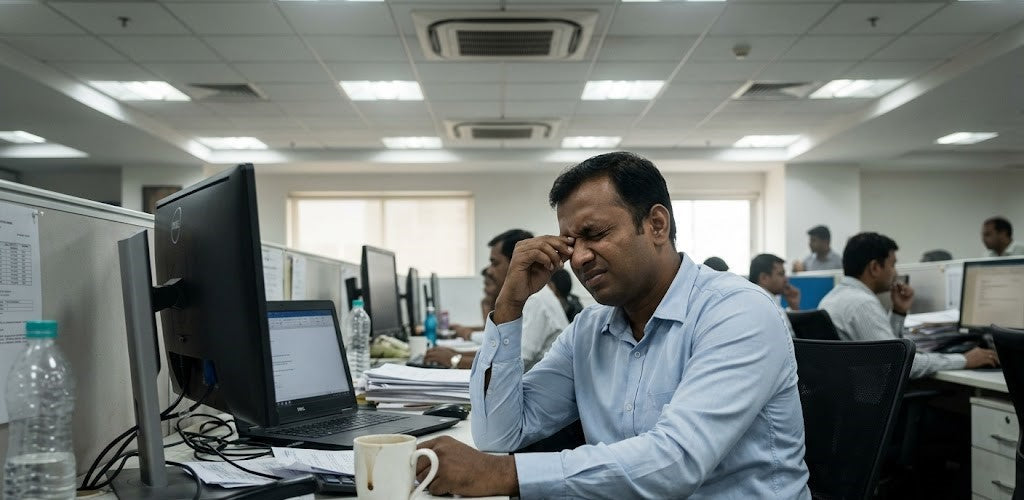
TL;DR
Indoor air in sealed offices runs 2 to 5 times more polluted than outside. PM2.5 and CO2 accumulate continuously in closed spaces. Most people cannot identify the source until they actually test.
What is quietly building up in your office air every day:
- Sealed HVAC recirculates fine particles without filtering them
- CO2 climbs steadily from 9am onwards in any occupied, air-conditioned space
- VOCs off-gas from furniture, carpets, and printers at low but continuous levels
- Symptoms appear on office days and clear on days off, a pattern most people never connect
Testing confirms what your body is already reacting to. And when your employer will not act, personal protection is your only real option.
Want to know how to test your office air and what to do about the results? Keep reading.
What Are the Most Telling Signs of Poor Indoor Air Quality in Office Buildings You Should Never Ignore?
The signs of poor indoor air quality in office buildings are genuinely easy to explain away and that is kind of the whole problem.
Persistent afternoon fatigue that clears up on weekends? Most people blame the workload. Eyes that feel dry and irritated by midday even when you slept fine. A slightly scratchy throat that shows up on workdays and is gone by Saturday. Difficulty concentrating after lunch that feels worse than just food coma. Occasional low-grade headaches that seem to follow your office schedule more than anything else.
Each one on its own, easy to dismiss. But getting most of them consistently, on office days and not on days off.. that pattern is worth paying attention to.
Your Monitor Found the Problem. Now Fix What You Can Control.
Atovio Pebble creates a clean air zone right around you. Filter-free, 40+ hours on a charge, and validated at 90% pollution reduction in 8 minutes at IIT Kanpur. No action needed from your employer.
Protect Your Breathing ZoneHow Does Indoor Air Quality Monitoring Reveal Pollution Levels That Are Invisible to the Naked Eye?
Here is what is interesting about indoor air quality monitoring, right. It measures the stuff your body is already reacting to before you consciously register anything is wrong.
A basic monitor tracks PM2.5, fine particulate matter small enough to reach deep lung tissue. It reads CO2 too, which climbs as the office fills and is directly linked to that foggy hard-to-concentrate feeling after 11am. Better monitors also pick up VOCs, the off-gassing from furniture, carpet, printers, continuous and invisible and something most people have never thought to measure at their desk.
What monitoring tends to reveal is that even clean-looking offices have PM2.5 above WHO levels by mid-morning. Neither visible. Neither smells like anything. Both affect how your body and brain function across the day.

How Do You Carry Out Reliable Indoor Air Quality Testing in Your Own Workplace?
Indoor air quality testing does not require expensive equipment or a specialist. Consumer-grade air quality monitors are available in India for Rs. 3,000 to Rs. 8,000 and give you real readings of PM2.5, CO2, and sometimes VOCs and humidity.
Place the monitor at desk height, not near a vent or cabinet. Run it through a full workday. Log readings when you arrive, mid-morning, after lunch, late afternoon. Four snapshots across the day is honestly enough to see what is happening. A single reading tells you almost nothing. The pattern across the day tells you whether pollution is just building steadily the whole time or whether something specific is spiking it, the printer kicking on, the AC cycling, someone heating lunch in the kitchen two desks over.
You are looking for PM2.5 consistently above 25 micrograms per cubic metre across the day and CO2 climbing above 1000 ppm by mid-morning. Both of those come up more often than people expect, even in offices that look and feel perfectly normal.

What Should Indoor Air Quality Testing Results Show Before You Know There Is a Genuine Problem?
The numbers to know: WHO recommends 24-hour average PM2.5 below 15 micrograms per cubic metre. ASHRAE recommends CO2 below 1000 ppm for occupied commercial spaces. Consistently elevated VOC readings alongside PM2.5 are a meaningful combined indicator.
Indoor air quality testing in most sealed Indian offices tends to show PM2.5 between 30 and 80 micrograms by afternoon and CO2 between 900 and 1400 ppm during peak occupancy. Both consistently above recommended levels.
These are not disaster numbers. But consistent exposure above recommended levels, every workday, for years, is what indoor air quality testing makes visible in a way your daily experience does not.

What Indoor Air Quality Solutions Are Available When Your Employer Refuses to Take Action?
Honestly, most employers are not going to act on this. You can flag it, share the monitor data, and sometimes things improve. But usually you are solving this yourself.
The structural indoor air quality solutions that move the needle are things like fresh air exchange adjustments, high-grade duct filters, regular duct cleaning. None of these are in your control as an employee. Facilities does them, they cost money, which is why they often do not happen.
What is in your control is your immediate zone. Opening a window for 10 minutes every couple of hours helps. A plant near your desk does marginally reduce certain VOCs, though it will not move PM2.5 meaningfully. Fresh air during breaks reduces the cumulative hit.
Does an Air Purifier for the Office Make a Measurable, Tested Difference to the Levels Around Your Desk?
Yes, though the answer depends on what kind and where it is placed. A shared air purifier for the office installed in the corner of a 50-person floor improves average room air quality somewhat. What it does not do is meaningfully change what you are breathing in the zone immediately around your face, because too much is happening between the unit and your desk.
Personal zone air purifiers, meaning devices that operate within a metre or two of your breathing space, have a much more direct effect on what you actually inhale. Studies on personal air purification in office environments have shown measurable reductions in PM2.5 and airborne bacterial exposure at the individual level even in spaces where room-level air quality is poor.
The mechanism matters. HEPA units catch larger particles but miss fine VOCs and nano-scale pollutants. Anion-based units release ions that bind to PM2.5, bacteria, and VOCs causing them to drop out of the breathing zone without a filter.
How Do You Improve Indoor Air Quality in Your Office When You Have No Control Over Ventilation?
You work with what you can change. To improve indoor air quality in your office when the infrastructure is out of your hands, the realistic options are: maximise the fresh air you get during breaks, reduce personal sources of pollution at your desk like heavily scented products and synthetic air fresheners, sit as far from printer stations as you can arrange, and invest in personal-zone air purification that works for you specifically, not for the average of the floor.
None of these fix the building. They reduce your exposure within it. The goal is not solving your employer's problem, it is protecting yourself while you are there.
Your First Defence Against Poor Office Air: Why a Wearable Air Purifier Works Where Nothing Else Can
Room-level solutions clean the room. A wearable air purifier cleans your zone. That difference is the whole argument.
The Atovio Pebble is a personal air purifier worn around the neck, 50 grams, filter-free, running on anion technology that has been tested at IIT Kanpur's National Aerosol Facility and validated at 90% pollution reduction in 8 minutes. Zero ozone output, confirmed by FARE Labs. 40-plus hours on a charge. The point is it goes where you go, desk to meeting room to the commute home, and it operates in your immediate breathing zone where shared units cannot reach.
8 Hours a Day in Poor Office Air. Protect What You Can.
Atovio Pebble is 50g, filter-free, and silent. It cleans your personal breathing zone at your desk, in meetings, and on the commute home. One charge lasts the whole week.
Get Personal Air ProtectionIs it going to fix your building's ventilation? No. Is it going to eliminate all exposure? No, it will not do that either. But for someone sitting in a sealed Indian office for 8 hours and getting consistently elevated PM2.5 and CO2 readings back from their monitor, it is a practical and tested reduction in daily exposure that requires nothing from your employer and nothing from facilities. You just wear it.
The rest of this series covers specific environments in more detail. Open Office Air Quality: Protecting Yourself in High-Density Workspaces, Does AC Purify Air? What Your Office Ventilation Actually Does, and Do Wearable Air Purifiers Actually Work.


Share:
The Complete Guide to Air Purifiers for the Office: 8-Hour Protection for Indian Professionals
How to Monitor Air Quality at Home When You Work From Home All Day - and What to Do About It